
For years, communications professionals have been taught to ask one question: How do we tell a better story?
It is a good question. I just don’t think it is the most important one anymore.
The question we need to ask is this: When someone goes looking for your organization, what story will they find?
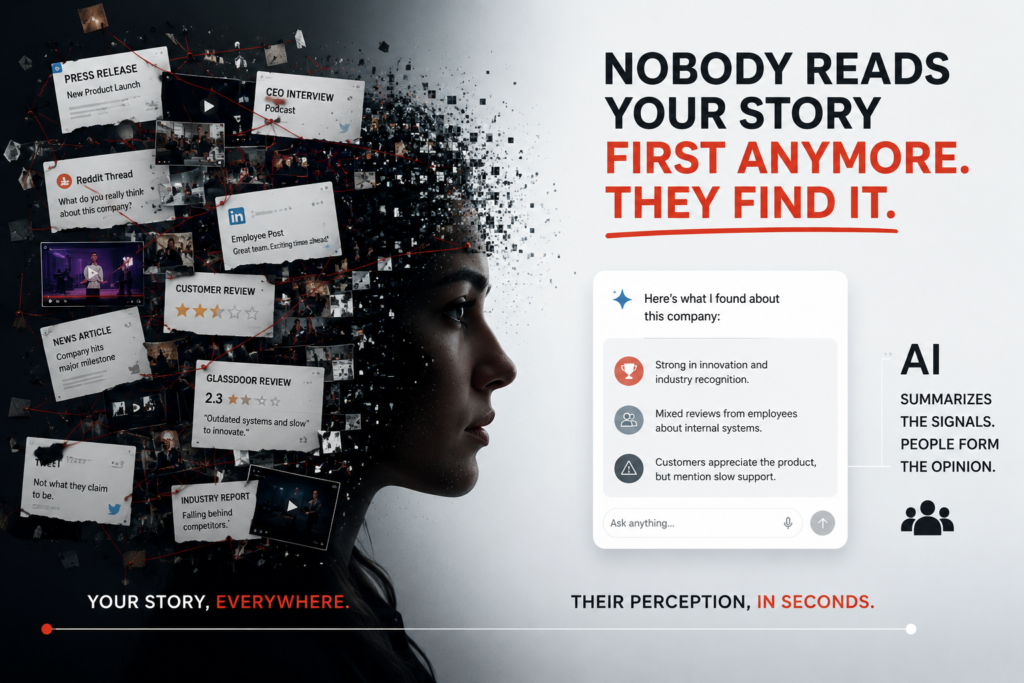
Because that is how reputation is built today. Not through a single campaign, a beautifully written press release, or a polished corporate homepage. People discover organizations through fragments: a founder’s podcast interview, a LinkedIn post from a mid-level engineer, a Reddit thread, or an AI-generated summary.
Audiences do not read your story from beginning to end. They assemble it.
Take Liquid Death. On paper, it sells canned water, a product that should be almost impossible to differentiate. Yet ask people what they know about the brand, and very few mention the product itself. They talk about its unapologetically rebellious personality, heavy-metal aesthetic, viral campaigns, and founder interviews.
That reputation wasn’t built by a single campaign.
It emerged from hundreds of consistent touchpoints that all reinforced the same narrative.
Long before many consumers ever visited its website, they already knew what the brand stood for.
That’s not just storytelling.
That’s discoverability.
And I think that’s where communications is quietly evolving.
A press release is no longer the finish line. It’s one signal among many.
A keynote becomes evidence.
A customer story builds trust.
A podcast interview adds context.
An employee’s LinkedIn post reinforces culture.
Individually, these moments seem insignificant. Collectively, they become the body of information people and, increasingly, AI systems, use to understand your organization.
The 2027 Communications Challenge
As we move toward 2027, another shift is accelerating this change.
People are no longer searching for information the way they did a decade ago. Instead of opening ten browser tabs, they’re asking ChatGPT, Claude, Google’s AI Mode, or Perplexity a question and accepting a synthesized answer in seconds.
Those answers aren’t created from your latest press release.
They’re generated by identifying patterns across everything that already exists about your organization: news coverage, executive interviews, research reports, employee conversations, public forums, customer reviews, and your owned content.
In other words, AI doesn’t simply repeat your messaging.
It reconstructs your reputation.
Imagine a company that proudly positions itself as an innovation leader.
Its newsroom says it’s transforming the industry.
Its CEO talks about cutting-edge technology.
But employees consistently describe outdated systems, customers complain about slow product development, and independent analysts question its market position.
An AI assistant won’t choose one version of the story.
It will synthesize all of them.
That’s the communications challenge we’re entering.
The biggest risk in 2027 won’t be producing too little content.
It will be managing too much inconsistent information.
Because discoverability isn’t about publishing more.
It’s about ensuring that every credible signal points in the same direction.
That changes the role of communications entirely.
We’re no longer just crafting narratives.
We’re curating an ecosystem of evidence.
And in a world where AI increasingly becomes the first point of contact between people and brands, the organizations that win won’t necessarily be the ones telling the best stories.
They’ll be the ones whose stories remain the easiest to find, the hardest to contradict, and the simplest to trust.